
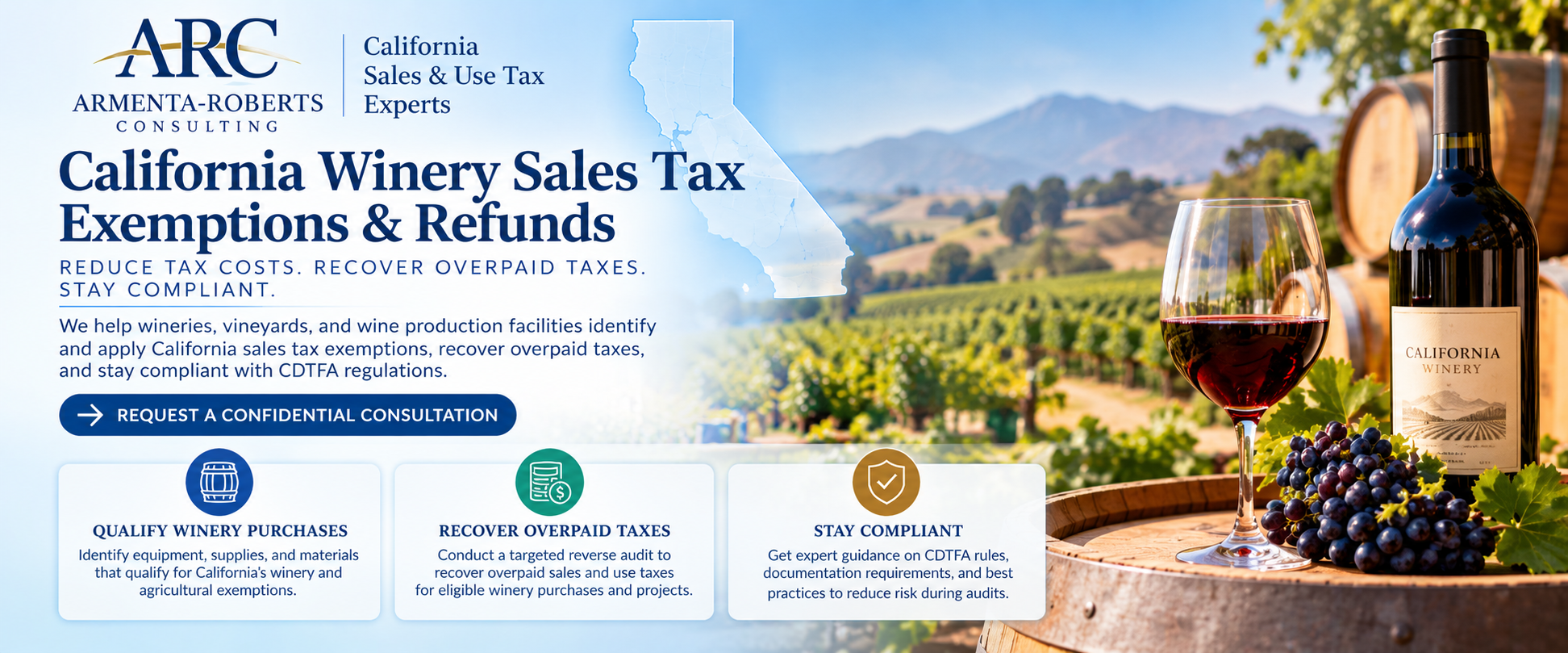
California Winery Sales Tax Exemptions & Refunds
Reduce Tax Costs. Maximize Available Exemptions. Recover Overpaid Taxes.
California wineries, vineyards, and wine production facilities face complex sales and use tax regulations that can affect operating costs and profitability. From grape processing and fermentation equipment to bottling machinery, storage systems, and vineyard operations, understanding which purchases may qualify for California sales and use tax exemptions can uncover valuable opportunities.
Armenta-Roberts Consulting (ARC) helps wineries identify potential tax savings, evaluate qualifying equipment and purchases, and pursue eligible refunds through targeted sales and use tax reverse audits. Our work considers both manufacturing equipment exemptions and other applicable rules, because eligibility depends on the purchaser, equipment, use, and transaction.
Led by Joan Armenta-Roberts, with more than 35 years of California sales and use tax experience, ARC provides specialized guidance on California Department of Tax and Fee Administration (CDTFA) regulations, refund claims, exemption documentation, and audit defense.
Whether you operate a boutique winery in Napa Valley, a vineyard in Sonoma County, or a large wine production facility in California's Central Valley, ARC can help evaluate opportunities while supporting compliance with California tax laws.
Request a Confidential Winery Tax Consultation →Qualify Winery Equipment & Purchases
Evaluate fermentation tanks, bottling equipment, processing machinery, agricultural equipment, and other purchases for potential eligibility under applicable California tax provisions.
Recover Overpaid Sales & Use Taxes
Review historical winery purchases and tax payments through a reverse audit to identify potential refunds, subject to documentation and filing deadlines.
Strengthen CDTFA Compliance
Get guidance on exemption certificates, purchase records, sales and use tax reporting, and audit preparation to help reduce unnecessary exposure.
Exemption and refund eligibility is fact-specific; no tax savings or refund amount is guaranteed.
California Winery Sales and Use Tax: Where Savings May Be Hiding
From vineyard operations to crush pads, fermentation rooms, bottling lines, and finished-wine distribution, California wine businesses purchase equipment and materials with very different tax treatments. A well-documented review can identify legitimate partial exemptions, overpaid sales or use tax, and purchasing procedures that need attention.
Armenta-Roberts Consulting (ARC) helps wineries and winegrowers evaluate their actual operations against applicable California Department of Tax and Fee Administration (CDTFA) rules. The goal is not to label every winery purchase exempt. It is to determine which specific transactions meet the requirements and to support those positions with evidence.
Two Major Partial Exemption Opportunities for California Wineries
Potential partial exemption for qualifying production equipment used in crushing, pressing, fermentation, bottling, and related manufacturing activities.
Potential partial exemption for qualifying tractors, harvesting machinery, irrigation equipment, and other agricultural tools used in commercial grape production.
Review purchases and prior tax payments for eligible refunds, vendor corrections, and improvements to future purchasing practices.
CDTFA separately addresses manufacturing and agricultural equipment in its Tax Guide for Winemakers.
Winery Manufacturing Equipment: What May Qualify?
Under Regulation 1525.4, a qualified purchaser may receive a partial exemption on qualified tangible personal property used primarily in a qualifying manufacturing process. The current statutory provision generally applies to eligible purchases before July 1, 2030, subject to changes in law.
CDTFA specifically identifies grape crushers, destemmers, presses, bottling equipment, and fermentation tanks as examples of winery equipment that may qualify. This does not mean every model, purchase, lease, or use qualifies. ARC examines the equipment, production process, ownership, use, and documentation.
| Equipment or purchase | Potential treatment | What must be reviewed |
|---|---|---|
| Grape crushers and destemmers | Potential manufacturing partial exemption | Production role, primary use, purchaser qualification |
| Wine presses | Potential manufacturing partial exemption | Where equipment fits in processing |
| Fermentation tanks | Potential manufacturing partial exemption | Actual production use and equipment documentation |
| Bottling machinery | Potential manufacturing partial exemption | Packaging as part of the qualified production process |
| Production testing and controls | Potentially eligible in specific circumstances | Connection to qualifying machinery or R&D activities |
| Finished-wine warehouse equipment | Often outside manufacturing exemption | Whether production is complete before storage |
| Tasting room displays and office furniture | Generally not qualified manufacturing equipment | Retail, administrative, or marketing function |
| Wine barrels, packaging, consumables | Requires separate item-specific analysis | Function, useful life, resale rules, other applicable law |
Examples are screening categories, not determinations of eligibility.
How Much Is the Manufacturing Partial Exemption Worth?
For qualifying purchases under the current manufacturing exemption, the rate reduction is generally 3.9375 percentage points. This is a partial exemption; local and district taxes may still apply. The precise tax calculation depends on the transaction and tax period.
| Illustrative eligible purchase | 3.9375% potential tax reduction |
|---|---|
| $50,000 | $1,968.75 |
| $150,000 | $5,906.25 |
| $500,000 | $19,687.50 |
| $1,000,000 | $39,375.00 |
Illustrations assume the entire stated purchase amount qualifies at the cited rate. These are not estimates of any particular winery’s entitlement or refund.
Vineyard Agricultural Equipment Exemptions
Qualified winegrowers may also be eligible for a separate farm equipment and machinery partial exemption. CDTFA states that this exemption currently applies to a 5-percentage-point state tax component for qualifying transactions; local and district taxes remain outside that reduction.
Potential categories include tractors, harvesters, vineyard sprayers, planting machinery, irrigation equipment, and qualifying repair parts. In general, the purchaser must be qualified and the property must be used primarily in commercial agricultural production or harvesting. Certain vehicles face stricter exclusive-use and classification requirements.
Critical distinction: Vineyard cultivation and grape harvesting may fall under agricultural provisions; post-harvest wine manufacturing generally needs to be assessed under manufacturing rules rather than assumed to qualify as farming.
See CDTFA’s winemaker industry guidance and Publication 66, Agricultural Industry.
Additional Winery Tax Issues Worth Reviewing
Packaging, bottles, labels, and closures
Packaging materials require their own analysis under resale and other applicable provisions. The fact that a bottling machine may qualify for a partial equipment exemption does not establish the treatment of bottles, corks, labels, cases, or other materials.
Leases, upgrades, and repair parts
Equipment leases, replacement parts, upgrades, and controls may present opportunities, but eligibility can turn on contract terms, useful life, and whether the property supports a qualifying activity.
Out-of-state equipment purchases and use tax
Equipment purchased outside California for use in the state may create use tax obligations. The proper amount depends on the transaction and available exemptions or credits; vendor billing alone does not establish the correct treatment.
Retail and tasting room operations
Retail sales, tastings, wine clubs, shipping, and hospitality activities have tax issues separate from the production-equipment exemption. They should be analyzed on their own terms and not blended into a manufacturing claim.
Alcoholic beverage taxes
Sales and use tax planning does not replace winery alcoholic beverage tax filing obligations. CDTFA maintains distinct guidance and reporting requirements for alcoholic beverage tax accounts.
ARC’s Five-Step Winery Tax Review
Discovery
Map vineyard, production, bottling, storage, and sales operations.
Purchase Review
Examine equipment, invoices, fixed assets, and tax payments.
Qualification
Test purchaser, property, use, and documentation requirements.
Recovery
Identify and support timely refund or vendor correction opportunities.
What Documents Should a Winery Prepare?
- Equipment invoices, vendor contracts, and purchase orders
- Fixed-asset ledgers and depreciation schedules
- Production process descriptions and equipment use records
- Vineyard machinery lists and agricultural-use records
- Sales and use tax returns and use tax accrual details
- Exemption certificates already provided to vendors
- Vendor credits, tax adjustments, and prior refund claims
- Relevant CDTFA audit notices and correspondence
ARC can help prioritize records based on likely opportunity size, age of transactions, and time-sensitive filing requirements.
California Wine Regions and Winery Operations We Serve
ARC assists wine businesses throughout California, including Napa Valley, Sonoma County, Paso Robles, Santa Barbara County, Lodi, Livermore Valley, Mendocino County, Amador County, El Dorado County, Monterey County, and the Central Valley. The same statewide tax framework can affect small estate wineries, custom-crush operations, vertically integrated vineyard-winery businesses, and larger wine manufacturers, although their purchasing patterns and eligibility can differ considerably.
Why Work With Armenta-Roberts Consulting?
Joan Armenta-Roberts brings more than 35 years of California sales and use tax experience, including experience with the former State Board of Equalization and major accounting firms. ARC applies that background to targeted exemption analysis, CDTFA audit defense, refund documentation, and practical purchasing controls.
Our approach focuses on evidence-based positions: which purchases qualify, why they qualify, which records support the claim, and what actions will help the winery stay compliant after the review.
Could Your Winery Be Overpaying California Sales or Use Tax?
Have ARC review your production equipment, vineyard machinery, and historical purchases for potential exemption and refund opportunities.
Request a Confidential Winery Tax Consultation →Frequently Asked Questions: California Winery Sales Tax Exemptions
These answers are general information. Eligibility and deadlines depend on the specific transaction and current law.
Do California wineries qualify for sales tax exemptions?
Potentially. Qualified winery manufacturing equipment and eligible vineyard agricultural equipment may receive different partial exemptions. Eligibility depends on the purchaser, equipment, actual use, transaction date, and documentation.
Is the manufacturing equipment exemption a full sales tax exemption?
No. Under the current rules the manufacturing partial exemption generally reduces the applicable rate by 3.9375 percentage points, not the entire sales tax.
Can fermentation tanks qualify?
CDTFA identifies fermentation tanks as examples of winery equipment that may qualify for the manufacturing partial exemption when all statutory requirements are met.
Do grape crushers and destemmers qualify?
They are listed by CDTFA as potential examples of qualified manufacturing equipment; actual use and purchaser eligibility must still be evaluated.
Can wine presses qualify?
Wine presses can potentially qualify as manufacturing equipment if the purchase and use satisfy the requirements.
Is bottling equipment eligible?
Bottling equipment is an example CDTFA identifies as potentially qualifying. The role of packaging in the manufacturing process and equipment use must be documented.
Are bottling supplies automatically exempt?
No. Bottles, closures, labels, cartons, and other consumable or packaging materials require separate tax treatment; do not assume the equipment exemption applies to every supply.
Does a vineyard tractor qualify?
A tractor used primarily in qualifying commercial agricultural production and harvesting may be eligible for the separate farm equipment partial exemption.
What about irrigation equipment?
Irrigation equipment may qualify under the farm equipment rules if the purchaser, equipment, and agricultural-use requirements are satisfied.
Are vineyard and winery exemptions the same?
No. Agricultural production and harvesting rules differ from the manufacturing rules that may apply to wine processing. A winery with both activities may need separate analyses.
Can one piece of equipment qualify under both programs?
Do not assume exemptions can be stacked. ARC evaluates the specific equipment and governing law to determine the correct treatment.
Is equipment used in tasting rooms eligible?
Equipment primarily used for retail, hospitality, marketing, or general administration generally does not qualify for the manufacturing equipment exemption.
Are wine barrels exempt?
The tax treatment of barrels depends on their use, useful life, and applicable provisions. They should be reviewed individually rather than treated as automatically exempt.
What about refrigeration and temperature-control systems?
Systems directly supporting a qualified production process may warrant review, while finished-product storage or retail refrigeration may be treated differently.
Can winery laboratory equipment qualify?
Testing and measurement equipment used primarily with qualifying manufacturing equipment or in qualifying research and development may warrant evaluation.
Are repair and replacement parts eligible?
Certain repair and replacement parts can qualify if they meet the applicable manufacturing or agricultural equipment rules, including relevant useful-life and use requirements.
Can leased winery equipment qualify?
Some leases may qualify for partial exemptions, subject to specific rules and proper documentation.
What does primarily used mean?
For many manufacturing and farm equipment provisions, primarily generally means at least 50 percent of the time in qualifying activities, although particular categories have stricter requirements.
Do agricultural vehicles have special rules?
Yes. Some vehicles regulated by the California Vehicle Code must be used exclusively in qualifying agricultural operations and satisfy additional requirements.
Can we recover sales tax already paid?
Possibly. A review can identify qualifying transactions and available refund or credit procedures, subject to proof, seller relationships, and filing deadlines.
What is a winery reverse audit?
A reverse audit examines historical purchases and tax payments to identify potential overpayments, missed exemptions, and improvements to future tax treatment.
Do we request the refund from the vendor or CDTFA?
It depends on who paid or remitted the tax and the transaction structure. A seller refund or adjustment may be needed in some situations; ARC helps identify the appropriate path.
What documents should we gather?
Purchase invoices, purchase orders, tax details, equipment lists, fixed-asset ledgers, use descriptions, exemption certificates, return records, and vendor correspondence are common starting points.
Can a winery correct its purchasing process going forward?
Yes. A review can help establish purchasing controls, documentation standards, and periodic checks so eligible exemptions are considered at the time of purchase.
Are out-of-state equipment purchases subject to California use tax?
They may be. The use tax consequences depend on how and where equipment is used and whether a valid exemption or credit applies.
Does the exemption cover local and district taxes?
Not necessarily. Partial exemptions generally affect specified state tax components; local and district taxes may remain due.
Are all California wine producers automatically qualified persons?
No. Qualification depends on applicable business-activity and other requirements. A business name or industry label alone is insufficient.
Does a pending CDTFA audit prevent a refund review?
Not automatically. However, open audit issues, limitation periods, and procedural rules must be coordinated carefully.
What should we do first?
Schedule an initial review of your winery operations, major equipment purchases, prior tax payments, and potential refund deadlines with ARC.
Industry Experience
Automobile Dealerships
Construction Contractors
Credit Unions
Entertainment
Farmers / Growers
Food Producers
Lending Institutions
Manufacturing
Packaging
Restaurants
Technology
Utilities
Video Games
Wineries