
Armenta-Roberts Consulting | California Sales & Use Tax Specialists
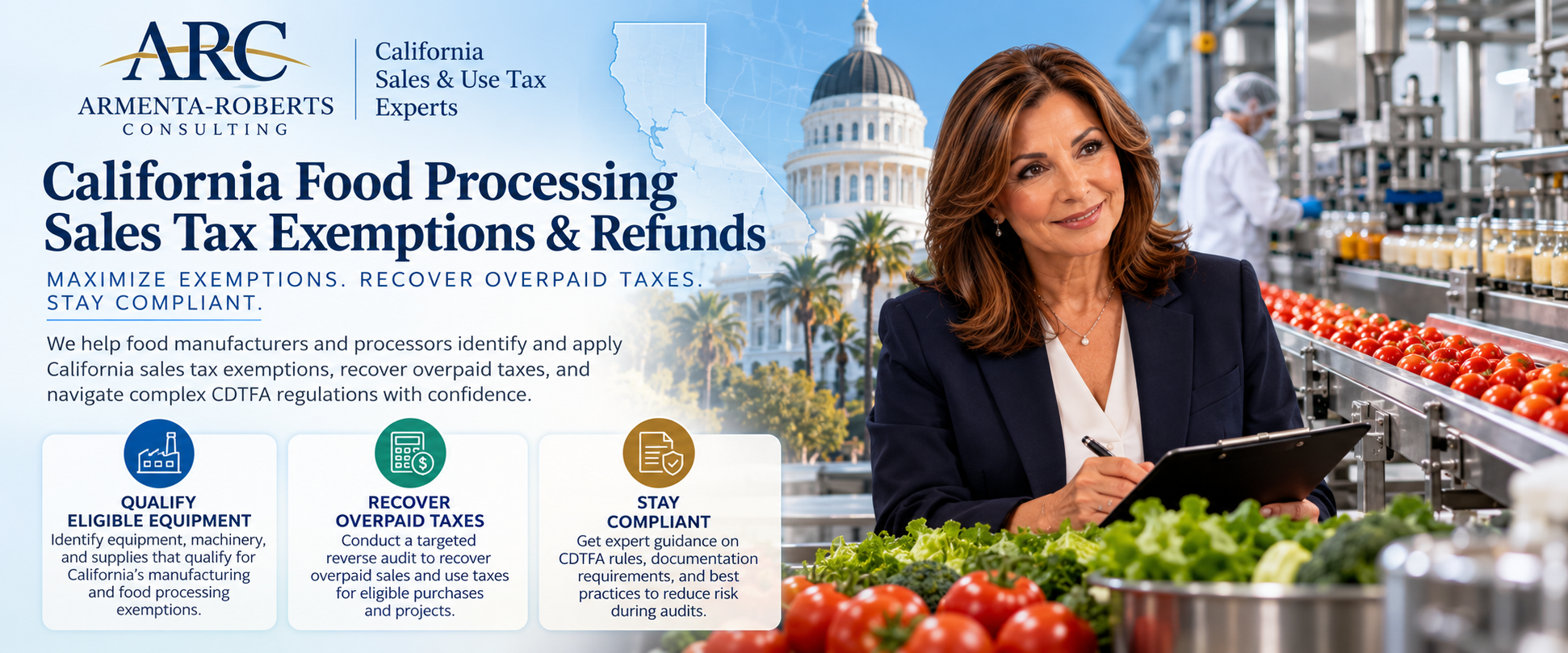
California Food Processing Sales Tax Exemptions & Refunds
Does your food processing business pay the full California sales or use tax rate on production equipment, packaging machinery, or other capital purchases? Certain qualifying purchases and leases may be eligible for a partial manufacturing exemption—and some past overpayments may be recoverable.
Armenta-Roberts Consulting (ARC) helps California food processors review equipment purchases, evaluate exemption eligibility, identify potential overpayments, and pursue properly supported refund claims.
Eligibility is transaction-specific. No exemption or refund is guaranteed. The page's detailed legal discussion and references should appear in the sections below.
Quick Answer: Can California Food Processors Save on Sales Tax?
Possibly. Certain qualifying food processors may receive a partial sales and use tax exemption on eligible manufacturing equipment and leases under California Revenue and Taxation Code section 6377.1 and Regulation 1525.4. Other rules may apply to qualifying food products, containers, and items purchased for resale. If a business paid too much tax, it may have a refund opportunity—but the correct claimant, documentation, and filing deadline matter.
Start here: Review equipment invoices, determine whether the business and property qualify, examine the property's use, and check the applicable refund period. Learn how ARC evaluates California sales tax refunds and reverse audits.
Which California Sales Tax Rules Matter Most to Food Processors?
Food processing is not governed by one blanket exemption. Several distinct provisions may affect the taxes charged on a processor's purchases or sales. They have different eligibility tests, documentation requirements, and exceptions.
A partial exemption may apply to eligible machinery and certain leases when purchaser, property, use, and timing requirements are satisfied.
Qualifying food products for human consumption generally receive favorable treatment under section 6359, but exceptions and transaction details matter.
Some containers and items incorporated into products sold may receive distinct tax treatment under container and resale rules.
ARC evaluates these provisions separately. A tax exemption on food sold to customers does not automatically exempt machinery, chemicals, office equipment, or every purchase made by a food manufacturer.
California's Manufacturing and Processing Equipment Partial Exemption
California's manufacturing and research-and-development equipment exemption is governed by Revenue and Taxation Code section 6377.1 and Regulation 1525.4. For eligible transactions during the applicable statutory period, the partial exemption reduces the applicable sales or use tax rate by 3.9375 percentage points; it does not eliminate all tax. Local and district tax components generally remain applicable.
For illustration only, if a transaction otherwise bears a combined 7.25% rate and meets all requirements, a 3.9375-percentage-point reduction would yield a 3.3125% effective rate. Actual rates, transaction dates, and eligibility must be verified. The current statutory sunset is scheduled for June 30, 2030, unless the law changes.
Four questions determine whether an equipment purchase warrants review
- Qualified person: Does the purchaser meet the statutory business-activity and classification tests?
- Qualified property: Does the equipment or other property fall within an eligible category?
- Qualified use: Is the property used primarily in an eligible manufacturing, processing, or other qualifying activity?
- Correct transaction treatment: Do the date, invoices, lease terms, certificates, and tax reporting support the claimed treatment?
For a deeper explanation, see ARC's California manufacturing sales tax exemptions guide.
Which Food Processing Businesses Might Qualify?
Depending on the statutory definition of a qualified person, the business's primary activities, and the property involved, candidates for review may include fruit and vegetable processors, commercial bakeries, dairy manufacturers, meat and seafood processors, grain processors, snack manufacturers, frozen-food producers, beverage manufacturers, and other food production businesses.
These examples are not a list of automatically exempt businesses. A food retailer, restaurant, warehouse, distributor, or mixed-use operation may have a very different analysis from a qualifying manufacturing business. Even within one company, different facilities and equipment may receive different treatment.
Food Processing Equipment: What to Review and What Not to Assume
The most productive review focuses on each asset's actual role in production, not simply its name on a purchase order. The table below identifies issues worth examining; it is not an eligibility determination.
| Equipment or purchase | Potentially relevant question | Common limitation |
|---|---|---|
| Mixers, grinders, slicers, ovens, processing lines | Is the equipment used primarily in qualifying manufacturing or processing? | Nonqualifying uses or business activities may prevent exemption. |
| Automated conveyors and filling systems | Is the equipment part of the qualifying production process? | Post-production distribution equipment may be treated differently. |
| Packaging machinery | Is required packaging part of the qualifying manufacturing activity? | Equipment and packaging materials have separate rules. |
| Refrigeration, chilling, temperature control | Does the equipment function within qualifying production? | Storage of completed goods alone does not establish eligibility. |
| Quality-control and testing equipment | Does it meet the regulation's specific qualifying-use provisions? | General laboratory or unrelated testing is not automatically eligible. |
| Production computers, controls, software | Are they used to operate, control, regulate, or maintain qualifying machinery? | Office and administrative systems usually require separate treatment. |
| Replacement parts and components | Do they satisfy property and useful-life requirements? | Short-lived consumables generally do not qualify merely as production inputs. |
| Machinery leases | Are the property and lease periods eligible, and how is tax measured? | Lease terms and the tax treatment of rentals matter. |
What Does “Primarily Used” Mean for a Food Processor?
California's manufacturing partial exemption generally uses a 50%-or-more qualifying-use test. The analysis requires looking at the equipment's actual or intended use and the regulation's definitions of qualifying activities.
For example, a machine used mainly to process raw ingredients into a finished product may warrant exemption review. A forklift used primarily to move finished goods through a distribution warehouse may not. A shared piece of equipment used for both qualifying production and unrelated functions requires a careful factual analysis.
Are Food Ingredients, Packaging Materials, and Containers Taxable?
Food products and ingredients
Revenue and Taxation Code section 6359 generally exempts qualifying food products for human consumption, subject to exceptions. Whether an ingredient, additive, or finished product qualifies depends on the facts and applicable law. A purchase of property incorporated into a product sold may also implicate resale rules; that is a separate analysis from the manufacturing equipment exemption.
Containers, labels, and wrapping
California's Regulation 1589 on containers and labels addresses tax treatment of different types of containers and related materials. Whether a container is returnable, nonreturnable, sold with its contents, or used for another purpose can change the result. Packaging machinery is a separate category from the packaging it produces or uses.
Cleaning chemicals and consumables
Materials consumed in operating or cleaning equipment do not become exempt solely because the processor manufactures food. Review their actual function and any applicable resale or exemption provision before treating them as nontaxable.
Can a California Food Processor Recover Tax Paid on Past Purchases?
Possibly. An invoice may show that a retailer charged the full tax rate on a qualifying equipment purchase. The business may also have self-reported use tax on a purchase that was partially exempt. Those situations can lead to different refund paths.
| What happened? | Typical refund consideration |
|---|---|
| Retailer collected sales tax reimbursement on a qualifying purchase | The purchaser generally coordinates with the retailer; the retailer may be the party filing the CDTFA refund claim, subject to statutory requirements. |
| Purchaser directly paid excess use tax to CDTFA | The purchaser may be able to file its own refund claim, with adequate records and within the applicable deadline. |
| Business claimed an incorrect deduction or used an incorrect rate | The filing and correction path depends on the original reporting, underlying transaction, and tax involved. |
Refund deadlines are governed by California law, including Revenue and Taxation Code section 6902. Do not assume all transactions remain refundable for three years or that a refund can be claimed indefinitely. The particular payment, return, claim, and statutory exceptions matter.
For the process, see CDTFA Publication 117 and ARC's sales tax refund and reverse audit service.
How a Food Processing Sales Tax Reverse Audit Works
A reverse audit is a review designed to identify potential overpayments rather than merely testing for underpayments. For a processor, it can combine equipment classification, invoice analysis, exemption documentation, and refund-period screening.
ARC's objective is to find legitimate, supportable opportunities. An initial review may identify no refund, or it may reveal transactions worth examining in detail.
Examples: Where Overpayments Might Arise
Example 1: A new production line
A food manufacturer installs a new processing line and is charged the full tax rate on equipment invoices. If the purchaser, equipment, and use satisfy the partial-exemption requirements, the business may have paid excess tax. Whether a refund is available depends on how the tax was paid, documentation, and timing.
Example 2: Mixed-use refrigeration
A facility uses one refrigeration system during production and another primarily to store completed products. The systems may require different treatment. A review should identify actual use instead of assuming both are eligible—or neither is.
Example 3: Packaging purchases
A processor purchases packaging machinery and also buys labels and containers. Machinery may implicate the manufacturing partial exemption, while labels and containers may be governed by separate rules. Combining the items under one general “packaging exemption” can produce incorrect conclusions.
These are hypothetical examples for illustration, not client results or promises of refunds.
Documents to Gather Before a Food Processing Tax Review
- Major equipment purchase invoices and vendor contracts
- Fixed-asset ledgers and depreciation schedules
- Equipment descriptions, process maps, and production-use information
- Machinery lease agreements and related tax invoices
- Exemption certificates and resale documentation, if any
- Sales and use tax returns and payment records
- Invoices for ingredients, containers, and packaging materials
- Prior CDTFA correspondence, audits, or refund claims involving the same issues
The precise documents needed depend on the claim. ARC can help identify a practical scope instead of requesting every business record indiscriminately.
Why Work With Armenta-Roberts Consulting?
More than 35 years of California sales and use tax experience
Joan Armenta-Roberts has more than 35 years of experience in California sales and use tax matters, including 17 years at the California State Board of Equalization and 18 years in major accounting-firm work, including PwC and KPMG.
Institutional knowledge and taxpayer advocacy
Through work involving the California Taxpayers Association (CalTax), Joan has participated in professional discussions with senior CDTFA personnel on tax administration, regulatory concerns, and taxpayer rights. Her background helps ARC analyze complex transactions and navigate administrative procedures through proper channels. These relationships do not imply preferential treatment or guaranteed outcomes.
Refund reviews and audit representation
Some food processing companies are also dealing with a CDTFA examination or disputed assessment. ARC provides assistance with California sales tax audit defense and CDTFA representation in addition to reverse audits and potential refunds.
Could Your Food Processing Business Have Overpaid California Sales Tax?
Have ARC review the facts: your operations, major equipment purchases, how the property is used, and whether timely refund procedures may be available.
Request a Food Processing Sales Tax Review →Frequently Asked Questions About California Food Processing Sales Tax
Open any question for a direct answer. All answers are included in the HTML source and remain available without JavaScript.
Do California food processors qualify for a sales tax exemption?
Some may qualify for the manufacturing equipment partial exemption or other transaction-specific provisions. Eligibility depends on the purchaser, the property, its qualifying use, and the applicable law.
Is all food processing equipment tax-exempt in California?
No. California generally provides a partial exemption for certain qualifying property, not a blanket exemption for all equipment purchased by food processors.
What is the California manufacturing equipment exemption rate?
For qualifying transactions during the applicable statutory period, the partial exemption reduces the applicable sales or use tax rate by 3.9375 percentage points. Other tax components generally remain due.
Does the exemption eliminate district taxes?
Generally no. The partial exemption is a reduction of specified state tax components; applicable local and district taxes may still apply.
Does a food processor have to meet a specific business classification?
Yes. The statutory definition of a qualified person includes qualifying business activity and classification requirements. The actual activities and legal entity must be reviewed.
What does “primarily used” mean?
Generally, qualifying property must be used 50% or more of the time in qualifying activities under the manufacturing partial-exemption rules. Actual use and the regulatory definitions matter.
Can mixers, grinders, and industrial ovens qualify?
They may, if the purchaser and property satisfy the statutory requirements and the equipment is used primarily in qualifying manufacturing or processing.
Does packaging machinery qualify?
Certain machinery used in required packaging as part of qualifying manufacturing may qualify. Packaging materials are analyzed under separate rules.
Is refrigeration equipment exempt?
It depends on its function. Refrigeration used in qualifying processing may warrant review, while refrigeration used primarily for finished-product storage does not automatically qualify.
Do conveyor systems qualify?
Conveyors used primarily in eligible manufacturing may qualify. Conveyors used primarily for finished-goods distribution may be treated differently.
Are replacement parts eligible?
Certain qualifying components and replacement parts may be eligible, subject to the statutory and regulatory requirements, including applicable useful-life rules.
Is manufacturing software exempt?
Certain computer equipment and software used to operate, control, regulate, or maintain qualifying manufacturing machinery may be eligible. General office software is not automatically eligible.
Can leased food processing equipment qualify?
Certain qualifying leases may receive the partial exemption. The property, lessee, lease period, and applicable tax treatment must be reviewed.
Are food ingredients exempt from sales tax?
Qualifying food products for human consumption are generally exempt under Revenue and Taxation Code section 6359, subject to exceptions. Ingredients and other materials may also require separate resale analysis.
Are food packaging containers exempt?
Some containers and labels may receive favorable treatment under California container and resale rules, depending on their type and how they are transferred or used.
Are cleaning chemicals exempt because they are used in production?
Not automatically. A material consumed in cleaning or operations must independently qualify under the applicable tax rules.
Can commercial bakeries qualify?
Some bakeries engaged in qualifying manufacturing activities may qualify. Retail operations and the actual business classification can affect the analysis.
Can wineries and beverage processors qualify?
Some may, depending on their qualifying manufacturing activities, equipment, and the applicable law. Wine and beverage businesses can also have industry-specific tax questions.
Can we recover tax paid on older machinery purchases?
Possibly, if the transaction qualified, an overpayment occurred, the correct party pursues the claim, and the applicable statutory filing deadline has not passed.
Who files the refund claim if a vendor charged sales tax reimbursement?
Often the retailer is the party that must pursue the sales tax refund from CDTFA, with the purchaser coordinating appropriate documentation and reimbursement. The exact circumstances should be reviewed.
Can we file a use tax refund ourselves?
A purchaser that overpaid use tax directly to CDTFA may be able to file a claim, subject to the applicable rules, records, and deadlines.
How far back can a food processor claim a refund?
The deadline depends on the particular tax, payment and return dates, claim, and statutory exceptions. Section 6902 is a starting point, not a universal deadline for every case.
Do we need a partial exemption certificate?
A properly completed partial exemption certificate is generally used to claim the manufacturing exemption from a retailer. The requirements and any correction process should be verified.
What if the equipment is used for both manufacturing and storage?
The primary-use requirement and actual equipment use must be analyzed. Mixed-use assets should not automatically be treated as fully qualifying.
What records are needed for a reverse audit?
Typical records include equipment invoices, fixed-asset schedules, leases, tax returns, exemption certificates, and evidence of how property was used.
Can an audit identify tax overpayments as well as underpayments?
Yes. CDTFA audits can examine both underpayments and overpayments. A separate reverse audit is designed specifically to identify potential overpayments.
Does a refund review guarantee money back?
No. ARC must first identify a qualifying overpayment, verify evidence, and evaluate the correct refund procedure and filing deadline.
Can ARC help during a CDTFA audit?
Yes. ARC assists with California sales and use tax audits, disputed findings, and related administrative procedures. See the Audit Defense service page for details.
Are these rules the same for restaurants and food distributors?
Not necessarily. Restaurants, retailers, distributors, and manufacturers may have different activities and tax treatments. Each business must be evaluated on its facts.
Should we change our tax reporting before getting a review?
It is prudent to verify eligibility and documentation before changing reporting or claiming an exemption. ARC can help identify issues for review and appropriate next steps.
Related ARC Services and Official California Sources
Explore ARC's services
- California manufacturing sales tax exemptions
- California sales tax refunds and reverse audits
- California sales tax audit defense and CDTFA representation
California primary authorities
- Revenue and Taxation Code § 6377.1 — Manufacturing equipment
- CDTFA Regulation 1525.4 — Manufacturing and R&D equipment
- CDTFA Manufacturing and R&D Equipment Tax Guide
- Revenue and Taxation Code § 6359 — Food products
- CDTFA Regulation 1589 — Containers and labels
- Revenue and Taxation Code § 6902 — Refund claim limitations
- CDTFA Publication 117 — Filing a claim for refund
Technical review: This page provides general information and is not a determination of tax eligibility. Tax laws, rates, dates, and administrative guidance may change. Joan or Zach at ARC should verify the legal statements, exemption calculations, links, and any case-specific implications before publishing. No refund or tax outcome is guaranteed.
Industry Experience
Agriculture (Farming)
Construction Contractors
Credit Unions
Entertainment
Food Producers
Lending Institutions
Manufacturing
Packaging
Printing
Restaurants
Technology
Utilities
Video Games
Wineries